Crow Machine
Want to learn more? Check out our official website at www.thecrowbox.com, where you can download a kit design and help develop the process!!
Below is the original page for the project. Go here for updated info.
The Goal
The goal of this project is to create a device that will autonomously train crows. So far we’ve trained captive crows to deposit dropped coins they find on the ground in exchange for peanuts. The next step is to see how quickly we can get wild crows to learn the system, and then how quickly they can learn it from each other.
Once we’ve got system down for teaching coin collection we’ll move to seeing how flexibly they can learn *other* tasks, like collecting garbage, sorting through discarded electronics, or maybe even search and rescue. The crows continue to amaze us with their abilities, so who knows?
The Device
The first version of the device consists of a box from which protrudes a perch, a food tray, and a funnel. The whole thing is made out of sealed wood so as to minimize noisy clanging which might result from using metal components while retaining the ability to leave the thing out in the rain. It is run by a laptop which provides power and control up to 50 feet away.
Based on established Skinnerian training principles, the action of the device is divided into four stages:
Stage One: Food and Coins Available on Departure.
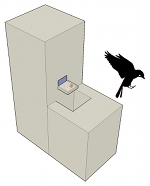
- At this stage the device pushes a few peanuts and one or two coins onto the feeder tray whenever a crow *leaves* the device. This ensures that the device always has food whenever it is examined by a potential feeding crow. It also ensures that both the sound of the device and its mechanical operation occur in close proximity to the feeding act so as to aclimate the crow. By having this noise occur as the crow leaves it prevents startling a potential feeder away from using the device.
Stage Two: Food and Coins Available On Landing.

- Herein the action of the device is identical except that food and coins are issued when a crow arrives. At this point the crow should be comfortable with the sound of the device and is now being trained to wait for its reward when arriving at the machine. Note that the feeding tray is slanted such that coins will pile up and prevent peanuts from being available until the crow cleans them away – a typical behavior of crows is to sweep things out of the way with their beak, and in this case this causes the coins to fall down the funnel. This should help reinforce the connection between coins going down the funnel and peanuts being produced.
Stage Three: Coins Available On Landing, Food Available on Deposit
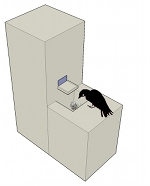
- This is the highest-risk segment of the machine’s operation. At this point coins alone are made available whenever the bird lands on the perch. However, should a bird peck or sweep coins off the tray and cause a coin to fall down the funnel, the device then produces some peanuts. This stage is designed to cement in the crows’ mind the relationship between coins going down the funnel and peanuts being made available.
Stage Four: Food Available On Coin Deposit

- Finally we shift the device into its intended, and long-term state of only providing peanuts when coins go down the funnel. Nothing is otherwise provided aside from coins scattered around the device at the beginning of the project.
If you’d like more details, I wrote a paper on the vending machine.
Press & Media
Previously I have presented on this topic at TED, Gadgetoff, and The Swedish Computer Science Institute. I also gave a 15-minute presentation on it as part of ITP’s thesis week. If that doesn’t grab you, Gizmodo did a nice little video review of it.
Radio pieces were done on Newstalk 106-108fm in Dublin, Ireland, Ifyourejustjoiningus.com, KOMO 1000 in Seattle, The CJ Radioshow, and NPR.
Articles have been written in Oprah Magazine, The Seattle PI, BoingBoing.net, Spice Magazine, The New York Times once, and then again in their Top Ideas of 2008 , Jeff Jarvis’ BuzzMachine, and Wired.
Oh, and if you speak German, it was also featured in Vögel Magazine.
Next Steps…
We’ve made a Creative Commons licensed, freely available design for the crowbox that anybody can download or buy as a kit. That means that anyone anywhere can make a version of the box and share their results with others, and we can test the machine with wild crow populations to see how to optimize the training process.
You can order it here. Alternately, feel free to donate to help us do more R&D on improving the design and conduct research into similar programs for other species.
or
Also see Zach Eveland of Blacklabel Development for more mad genius – he’s responsible for the electronics that made the original version of this project work.
29 Comments
Shandi
I wonder if crows may eventually begin finding coins that aren’t lost yet.
Bob
Hi Josh,
My Wife and I recycle left over food scraps for crows. We save beef and chicken scraps, including wings, bones, carcaces etc. I enjoy watching how they stash whatever they don’t eat buy tucking it under moss or leaves or stuff it into the crotches of tree brances, under rocks, logs etc., to come back and get later. I am truly amazed by how smart these birds really are. I would like to find out more about your peanuts for coins feeding device and see if it is something I could set up in our feeding area. It would be really interesting to see how smart these birds may be and what other things they can be taught.
Thanks for a great article,
Bob Towle
josh
Thanks! We’re working on a kit now, so you can either download and build a crowbox yourself, or just order one online. Watch this space for more info soon!
facebook_Rodger_Pruitt.100002317157759
I really don’t understand why this hasn’t gotten any spotlight, seriously, this is the most amazing idea I’ve seen. I actually came here after I saw one of your presentations on youtube. I would really like to know how, and if I could start one up in my area as well. Have you presented this idea to any cities as like a nonprofit for revenue for schools or supporting any other sort of cause that would be worth supporting? I think that would be pretty major.
josh
We’re working on a kit, in fact, and should have it available for pre-order soon. Watch this space!!
Charles Duffy III
How goes the kit/ blueprints? I live in new orleans and really want to build this and train the crows to get Mardi Gras beads out of trees! Big help for the city, fun for crows!
josh
It’s coming along! We’ll keep you posted!
josh
I love that idea!! We’re moving along and hope to have a kit anyone can order in another few months. We’ll keep you posted!!
best,
Josh
twitter_bryanajones
Josh, I just wondered how the kit was coming along?
I’ve just watched your segment on the Discovery channel here in the UK. Truly brilliant.
If you’re looking for funding to get this project moving, have you considered KickStarter.com? I’m sure you’ve heard of it already, but if not I think your Crow Machine would be an ideal candidate.
I look forward to owning my own Crow Machine some day soon.
Thanks
Bryan.
josh
Thanks!! We’re hard at work with it and hope to have the new kit up and ready in a few months’ time. We’ll keep you posted!!
best,
Josh
Nick
Josh have you considered losing the computer completely and opting in on using an arduino controller as well as solar panel. Your idea is amazing me and my brother were talking about doing this not to long ago and whule searching it online I found your site. Good luck and can’t wait to see your finished project.
Chris
Just wondering how the kit or plans are coming. I am ready to get this going in my area. I am a nuisance wildlife operator in Georgia and recieve calls about Nuisance crows around chicken farms alot. My thoughts are to give them a useful job and unlimited alternate food source to prevent predation and chicken food loss thus preventing the useless shooting by farmers in my area. Please let me know of any updates know
SAS
when will the vending machine be ready for order? i want one! 🙂
josh
It’s available to alpha testers at http://www.thecrowbox.com! Sign up there to be notified as to when the beta version is out. 🙂
Sean Reinholtz
Would small, coin like objects such as bottle caps get into the coin sorter and clog it up?
josh
The way it’s designed right now (see http://www.thecrowbox.com) it’ll only accept coins. Everything else gets dumped out the back of the chute. The reason for the design choice is that crows are wicked smart, and every captive crow I’ve tested it with has shoved something *other* than coins into the box in an attempt to more easily get treats. One of the biggest challenge in making the machine was getting it to accurately recognize *only* the inputs you want.
John in Newfoundland
A small step from coins to litter. Can you train a crow to retrieve refundable plastic bottles? This might prove challenging to a major funding source for the homeless but it would help clean up inaccessible areas.
It could drive local politicians nuts because they are collecting recyclables as a funding source for cities too.
josh
Sounds like a good idea to me – although I wonder how well crows could fly with a soda bottle in their beak. Check out the kit; maybe you can modify it: https://www.thecrowbox.com
Bryon Boyce
Have your trained crows successfully trained wild ones?
Have they started collecting coins other than the ones you scatter around the vending machines?
You have estimated profit per peanut – in practice are the crows paying for the machine yet?
josh
We’ve just finished the Alpha versions of the CrowBox kit to community source innovation around training wild crows. Check out http://www.thecrowbox.com for more info!
John in Newfoundland Canada
I suspect that the crows are never going to pay for the machine, as I believe that the trained crows will be unlikely to find themselves in a target-rich environment. That is why I suggested that refundable containers would be a better choice. I see discarded bottles and cans everywhere but I rarely see coins laying around. The containers are also worth more than small coins. I don’t think that plastic bottles or metal cans would pose insurmountable flying problems for a bird as large as a raven or crow.
Corey
Hey, going to build a variation of the machine myself here in Australia, the local species of crow here is the Torresian Crow. A question before I dive into the project though, how much success has been had with wild populations? Has any tester been able to replicate the behavior of the captive crows? Thanks!
josh
We’ve just sent out the alpha version of the box to our initial roster of testers. Based on their feedback we’ll iterate the design and see what sort of results we can get with wild crows. If you want to base yours off our design, it’s open-sourced at http://www.thecrowbox.com !!
Alejandro Mendoza
Have you ever successfully trained wild crows?
josh
That’s the goal of http://www.thecrowbox.com – to get the kit in the hands of alpha testers so as many different methods of training are able to be tried as efficiently as possible. By sharing our experiences we should be able to determine the quickest way to train the crows, as well as to improve the design of the box so anyone can make one.
SwearyCrow
It wouldn’t work where I live. The Herring Gulls would smash the box up and steal all the peanuts.
josh
Possibly – the boxes are made to be pretty strong, and if held down the gulls shouldn’t be able to smash them too much. FWIW, When we took the original design out to a recycling dump gulls and crows and pigeons all took a try at it, and only the crows really gave it a good go, getting on top of it and trying to get inside.
Sue Spittal
We are excited by you crow box project and would like to mparticipate by using a differnt species of crow.
How do we buy a crows box?
josh
Check out http://www.thecrowbox.com !!